



For professionals operating in harsh environments—military, defense contractors, disaster response, remote infrastructure—standard consumer phones simply won’t cut it. You need a rugged military mobile phone that’s built for the field: one that survives impact, dust, water, extreme climates, and long operational hours.
This checklist explains exactly what you should verify (and why), centered around the certifications MIL-STD-810H, IP68/IP69K, and battery endurance—and shows how to choose a device that works when it matters most.
Why “rugged military mobile phone” matters
In the field, every device becomes a tool. A phone serves as comms link, GPS navigator, incident logger, camera, and direct feed to command. If it fails due to dust ingress, hose-down spray, drop from a vehicle rack, or drained battery mid-mission, the consequences aren’t just inconvenience—they’re operational risk.
That’s why military-grade rugged phones exist: they combine standardized durability, validated ingress protection, high capacity battery, and mission-ready connectivity. According to industry testing, phones built to MIL-STD-810H endure vibration, shock, extreme heat/cold, and dust far better than standard phones.
Meanwhile IP-certifications like IP68 and IP69K tell you how well the device keeps dust and water at bay. When you tie that together with dual-SIM for field deployments, you have a true rugged military mobile phone—not just a “rugged phone” rebranded.
The core checklist for a rugged military mobile phone

Here’s a field-usable checklist to evaluate a device before you deploy it:
1. MIL-STD-810H compliance (or equivalent)
- Look for explicit mention of MIL-STD-810H tests like Shock (Method 516.8), Vibration (514.8), Temperature extremes, Humidity, Transit Drop. According to Samsung’s corporate insights, MIL-STD-810 “helps ensure technology is tough enough for battlefield use.”
- Ask for actual drop heights and surfaces (e.g., 1.5 m onto concrete, multiple angles). Generic “military grade” labels may hide weak test coverage.
- Ensure the manufacturer states which test methods were applied—not just “mil-spec” as a marketing phrase.
2. IP68 + IP69K ratings
- IP68 means full dust-tight (6) and rated for immersion in water beyond 1 m for a defined time.
- IP69K means protection from high-pressure, high-temperature water-jets / industrial spray. Useful for wash-down environments or heavy-duty gear cleaning.
- For military/field use you want both if possible—immersion + spray + dust. Devices listing IP68/IP69K + MIL-STD are ideal.
- Note: ratings can degrade with wear, battered seals, or after extreme impacts.
3. Battery endurance & power management
- Mission time often outlasts lunch breaks. Rugged military mobile phones need large capacity batteries (10,000 mAh or greater) and power saving modes.
- Features such as reverse charging (so the phone can act as power bank for radios or other gear) are strong pluses.
- Verify maintenance cycles and battery replacement support—field devices often need to stay in service years.
4. SIM card / dual-SIM & network resilience
- Field deployments often require dual SIM (one local carrier / one backup) or rugged SIM card trays that won’t easily detach under vibration.
- Check coverage bands for your region/military network—LTE fallback, 5G readiness, frequency support matter.
- Rugged military mobile phones often include extra connectivity features: PTT (push-to-talk), smart key, rugged accessory compatibility.
5. Field usability & physical build
- The device must be glove-friendly/wet-touch: thick-glove users on tactical gear or muddy work sites can’t navigate a tiny screen.
- Raised bezel, textured grip, corner bumper protection—these matter more than thinness.
- Loud speaker and robust mic: field comms require clarity in noisy environments.
6. Repairability & lifecycle support
- Software: Ensure device ships with or supports Android 15 (as per your requirement for current software).
- Check warranty terms and parts availability in the region of deployment.
Why these items matter together
 Choosing a phone that only has IP68 but no drop testing puts you at water-safe but risk of cracked screen after gear shift. A phone with MIL-STD but weak water ingress may suffer corrosion in rainy deployment. A large battery with no network resilience or SIM flexibility means you may have power but no communications.
The best rugged military mobile phone covers all these bases—durability, ingress protection, power, connectivity, and field usability. Many reviews of top rugged models note that what makes the “best rugged phone of 2025” is actually the combination of certs, battery, and connectivity, not just one standout spec.
Real-world deployment scenarios
- Tactical field operations: Hot, dusty terrain; immersion risk (rains or river crossing); need for drop resistance when climbing terrain. Requires IP68/IP69K + MIL-STD + large battery + dual SIM + glove mode.
- Construction/defense contracting site: Dust, concrete splatter, hose-downs of equipment, long shifts. Rugged military mobile phone needs water-jet protection plus shock resistance.
- Disaster response / logistics: Vehicle mount, extreme vibration, multi-shift battery demands, network switching between SIMs.
- Remote infrastructure maintenance: Off-grid power, long battery days, weather extremes, dual SIM for local carriers.
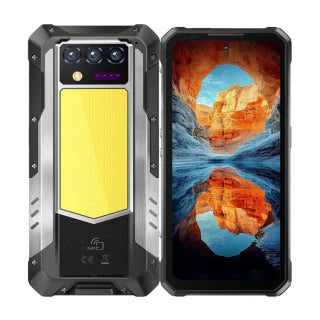
Example device: OUKITEL WP100 Titan (as a rugged military mobile phone candidate)

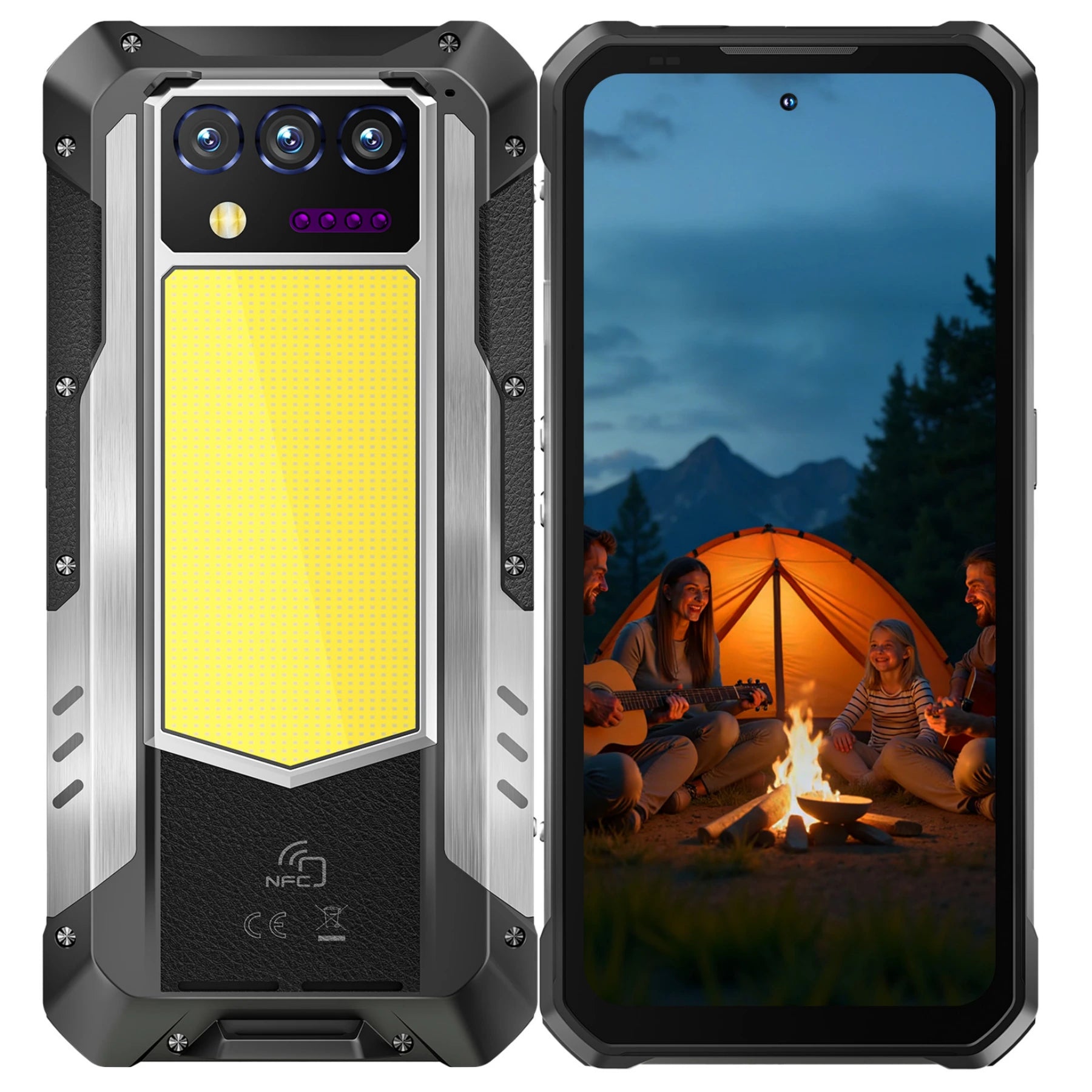
Here’s a glimpse of how one model can align with the rugged checklist. The OUKITEL WP100 Titan combines ultra-high-capacity power (up to 33,000 mAh in some editions) with a field-ready, rugged-certified design. Its features include a built-in 1200-lumen Camping Light, a 100-lumen Projector, 18W reverse charging to power small devices, fast 33 W charging, and massive storage(up to 48GB RAM & 512GB storage) to handle maps, media, and large files. Together with MIL-STD/MIL-810H drop protection, IP68/IP69K waterproofing, and reinforced port covers, it’s ideal for military, defense, or extreme outdoor use.
While exact specs like drop height, ingress rating, SIM tray design, and software version should always be confirmed per SKU, the WP100 Titan showcases what a modern high-end rugged phone can deliver.
Buying mistakes to avoid
- Accepting “military grade” as marketing without details (no test method numbers).
- Focusing on thinness or style over actual durability specs.
- Ignoring real drop testing or glue-seal durability—ingress seals degrade.
- Buying a battery monster but forgetting network bands or SIM configuration.
- Overlooking software support—older Android builds may lack security patches.
- Assuming standard consumer phones suffice for “rugged” tasks—they often fail in industrial or military conditions.
Frequently Asked Questions
What does MIL-STD-810H actually test?
It’s a U.S. DoD standard covering many test methods (shock, vibration, temperature, humidity, sand/dust, immersion, etc.). A device with MIL-STD-810H means it’s been through some of those tests.
Is IP69K better than IP68?
They test different hazards. IP68 is dust-tight and immersion resistant; IP69K protects against high-pressure/temperature water jets. A phone with both gives broader coverage.
Does dual SIM matter for military/field use?
Yes. Dual SIM gives fallback network options, local carrier access, and operational flexibility in multi-country deployments.
Can a rugged military mobile phone be too bulky?
Possibly—but durability often demands size and weight. Consider holsters or vehicle mounting rather than pocket carry if weight is a concern.
Final thoughts
A rugged military mobile phone isn’t just about one spec—it’s the combination of certified durability, ingress protection, power endurance, field-usable design, and network readiness. Use the checklist above to vet devices against real operational demands.
Choose gear that won’t compromise when it’s mission-time: water-proof when it pours, drop-resistant when gear shifts, battery-strong when you’re beyond the outlet, and dual-SIM ready when networks vary.


Leave a comment
Your email address will not be published. Required fields are marked *