


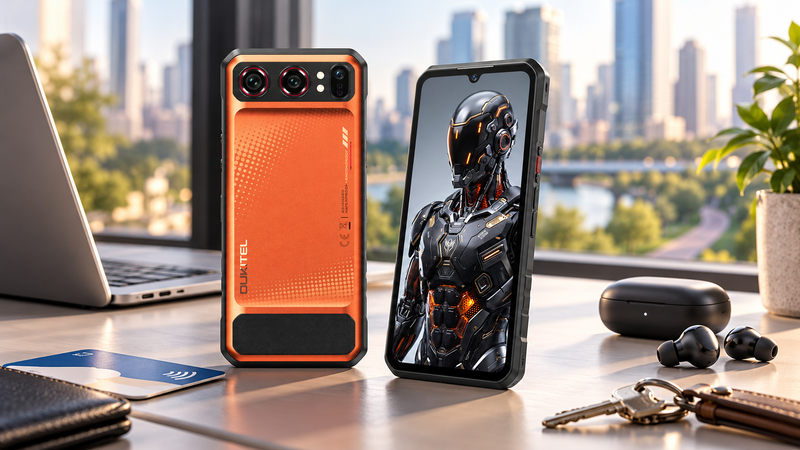
The OUKITEL WP68 Air is an unusually slim rugged phone, combining an 11.9mm body with an 8,000mAh silicon-carbon battery. At 309.5g, it is designed for people who want more protection and battery capacity than a conventional smartphone without carrying one of the thickest, heaviest rugged models.
Calling any model “the thinnest rugged phone” requires caution because there is no universal database covering every brand, region, and release. However, the WP68 Air’s verified dimensions place it firmly in the slim end of the rugged-phone category. Its silicon-carbon battery helps make that combination possible, although battery chemistry is only one part of the design.
How Thin Is the OUKITEL WP68 Air?

The WP68 Air measures 11.9mm thick and weighs 309.5g. Those figures make it substantially easier to carry than many high-capacity rugged phones, which often exceed 20mm in thickness and weigh more than 500g.
An 11.9mm body is still thicker than most mainstream smartphones. The important comparison is therefore not whether the WP68 Air feels identical to an ordinary glass phone, but how much bulk it removes while retaining a reinforced enclosure, sealed construction and a larger battery.
An 11.9mm Rugged Phone Designed for Easier Everyday Carry
Thickness affects more than appearance. A slimmer phone is generally easier to slide into a pocket, hold during a long call and use for navigation without placing as much strain on the hand.
Weight matters just as much. At 309.5g, the WP68 Air is heavier than a typical consumer smartphone, but considerably lighter than many rugged models built around batteries of 16,000mAh or more.
This difference can be meaningful for:
- Field workers carrying a phone throughout a shift
- Hikers trying to reduce pack and pocket weight
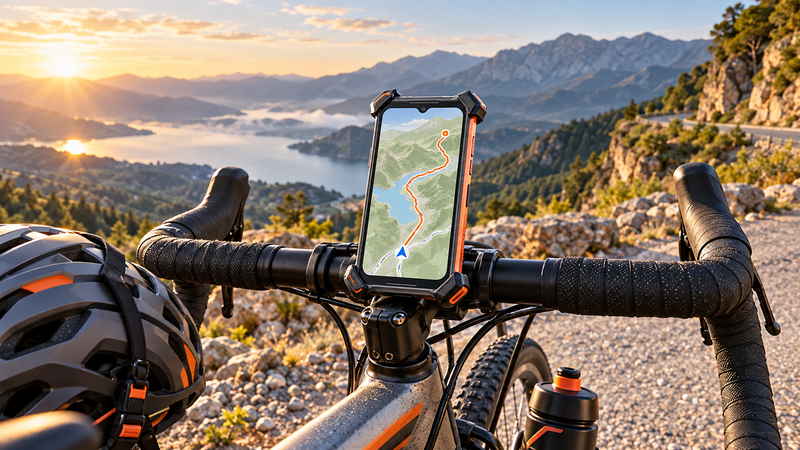
- Drivers mounting a phone for navigation
- Technicians using mobile forms and work applications
- Everyday users who want protection without extreme bulk
The slim profile does not eliminate every handling concern. Buyers should still consider pocket size, hand size, case use and mounting compatibility before choosing a device.
Why Thickness, Weight, and Grip Matter More Than One Number
Thickness alone does not determine comfort. Edge shape, weight distribution, button position and surface texture affect how secure a phone feels.
A very thin glass phone may be light but slippery and vulnerable to impact. A rugged model may feel more substantial while offering reinforced corners and a textured frame. The better design depends on the user’s environment rather than the smallest measurement.
When comparing rugged phones, consider the complete combination:
| Specification | What it affects |
|---|---|
| Thickness | Pocket fit, mounting and one-handed handling |
| Weight | Carrying comfort and fatigue during extended use |
| Battery capacity | Potential runtime between charges |
| Frame and corner design | Grip and impact protection |
| Water and dust rating | Suitability for wet or dusty environments |
| Charging power | Time required to restore the battery |
For a wider look at these tradeoffs, see the rugged phone buying guide.
Why Rugged Phones Are Usually Thick and Heavy
Rugged phones must protect components that remain relatively delicate. Screens, circuit boards, cameras, connectors and batteries can all be affected by impact, moisture, dust and temperature.
Manufacturers typically create protection by adding reinforced corners, shock-absorbing structures, seals, protective port covers and stronger exterior materials. These components occupy space and add weight even before battery capacity is considered.
Protective Frames, Sealing, and Reinforced Components Add Bulk
A normal smartphone is often designed around a thin glass-and-metal enclosure. A rugged phone has different priorities. Its housing may need to keep its shape during a fall, reduce the force reaching internal components and maintain a seal around openings.
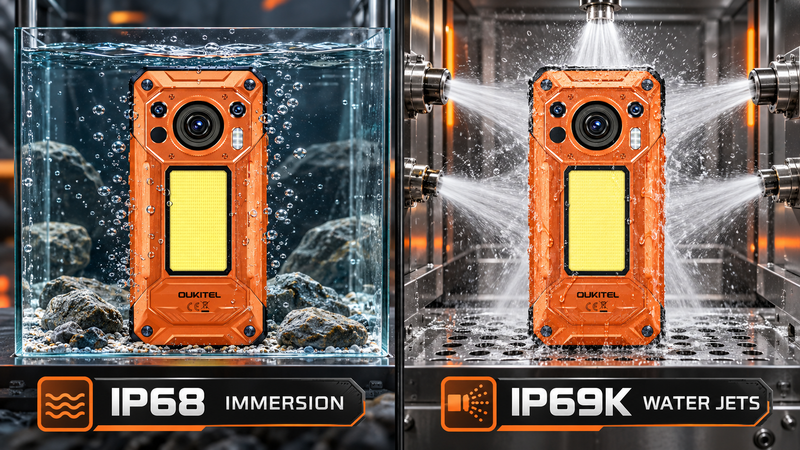
The WP68 Air is listed with IP68, IP69K and MIL-STD-810H protection. These labels indicate testing against defined environmental conditions; they do not mean the phone is indestructible.
IP68 and IP69K also address different water exposures. IP68 covers dust protection and immersion under manufacturer-specified conditions, while IP69K concerns high-pressure, high-temperature water jets. OUKITEL’s guide to IP68 and IP69K ratings explains these differences in more detail.
Water resistance can deteriorate after impact, wear or seal damage. Charging ports should be clean and dry before use, and saltwater or chemical exposure should not be treated as equivalent to controlled freshwater testing.
Large Batteries Create an Additional Design Challenge
A larger-capacity battery generally requires more internal volume. That is why some rugged phones designed for multi-day endurance are exceptionally thick and heavy.
High capacity can be worthwhile at a remote worksite or basecamp, but it may be excessive for someone who charges regularly and carries the phone all day. The best battery size depends on the balance between runtime and portability.
The WP68 Air approaches this problem differently. Instead of competing for the largest possible battery, it uses an 8,000mAh cell and a slimmer structure to create a more manageable everyday device.
For buyers prioritizing maximum off-grid endurance instead, the OUKITEL WP61 offers a 20,000mAh battery but is correspondingly larger and heavier. This illustrates why battery capacity should never be compared without dimensions and weight.
How Silicon-Carbon Battery Technology Enables a Slimmer Design

A silicon-carbon battery is still a lithium-ion battery. The term refers to the use of silicon-containing material combined with carbon in the anode rather than relying only on a conventional graphite-based design.
Silicon can store more lithium per unit of active material than graphite. In commercial batteries, it is normally combined with carbon and supported by careful material engineering because silicon expands significantly during charging.
Silicon-carbon battery technology introduces silicon into the anode material, allowing the battery to store more power without requiring additional volume. This is the key technology that helps the WP68 Air combine an 8,000mAh battery with an ultra-slim 11.9mm body.
Higher Energy Density Compared With Conventional Graphite-Based Designs
Higher energy density means more energy can be stored within a given mass or volume. For a phone designer, that can support one of two goals:
- Increase battery capacity without increasing the device by the same proportion
- Preserve the target capacity while reducing the space required by the battery
The WP68 Air uses the second benefit to support a slimmer rugged-phone design. According to its official specification page, it combines:
| WP68 Air specification | Official value |
|---|---|
| Battery capacity | 8,000mAh |
| Battery material | Silicon-carbon polymer |
| Body thickness | 11.9mm |
| Weight | 309.5g |
| Input charging | 45W |
| Reverse charging | Supported |
| Rugged ratings | IP68, IP69K and MIL-STD-810H |
Specifications were checked on September 3, 2026. Availability, regional configurations and software details may change, so buyers should verify the current OUKITEL WP68 Air product page before purchasing.
Why Battery Chemistry Is Only Part of the Slim-Phone Equation
It would be inaccurate to attribute the complete 11.9mm design to the battery alone. The final dimensions also depend on:
- Battery shape and packaging
- Circuit-board layout
- Cooling and thermal management
- Display construction
- Camera-module depth
- Exterior reinforcement
- Antenna placement
- Sealing around ports and buttons
Silicon-carbon technology provides an important advantage, but achieving a slim rugged phone requires the entire device to be designed around efficient use of space.
It is also important not to confuse silicon-carbon batteries with solid-state batteries. The WP68 Air uses a silicon-carbon polymer lithium-ion battery; it is not advertised as a solid-state device.
Readers interested primarily in the chemistry can find a more technical explanation in What Is a Silicon Anode Battery?. This article instead focuses on how that technology affects the WP68 Air’s portability and practical use.
Does a Slimmer Body Compromise Rugged Protection?

A slimmer rugged phone has less physical volume available for protective structures, but thickness alone does not establish durability. Test ratings, enclosure design, materials and construction quality provide more useful evidence.
The WP68 Air is rated IP68, IP69K and MIL-STD-810H. Its product page specifies IP68 freshwater immersion at 1.5 meters for up to 30 minutes.
These ratings support use around rain, dust and demanding working environments, but they should be understood as controlled test results rather than permission to expose the phone unnecessarily.
What the Ratings Mean in Practice
- IP68: Dust-tight enclosure protection and immersion resistance under specified conditions.
- IP69K: Protection under a defined high-pressure, high-temperature water-jet test.
- MIL-STD-810H: Testing based on selected environmental laboratory methods and conditions.
MIL-STD-810H is not a single universal certification that makes every tested product equally durable. Manufacturers may use different methods, procedures and test conditions. Buyers should examine the specific claims supplied for the device instead of interpreting the label as a damage-proof guarantee.
Drops onto sharp surfaces, damaged port seals, deep water, saltwater and prolonged chemical exposure can still harm a rugged phone. A slim rugged design reduces bulk; it does not remove the need for responsible handling.
What Is the WP68 Air Like as an Everyday Phone?
The WP68 Air is designed to work as a primary smartphone rather than only as emergency equipment. Its current specifications list a MediaTek Dimensity 7025 processor, 5G connectivity, 12GB of physical RAM, 512GB of storage and microSD expansion support.
The 6.88-inch display has a 120Hz refresh rate. Camera hardware includes a 64MP main camera, 32MP front camera, 8MP infrared night-vision camera and 2MP macro camera.
These features make it suitable for communication, navigation, documentation and everyday applications. However, buyers should check network bands against their carrier because the presence of “5G” does not guarantee compatibility with every network or region.
Charging and Real-World Battery Life
The phone supports 45W input charging, with the official page listing a full charge time of approximately one hour and 50 minutes under its test conditions.
Actual charging time can change with:
- Charger and cable compatibility
- Starting battery level
- Battery temperature
- Simultaneous phone use
- Background applications
- Charging protection behavior
The same applies to runtime. An 8,000mAh battery does not produce one fixed number of hours. Navigation, weak cellular signal, maximum display brightness, hotspot use, gaming and night-vision recording consume power differently.
Reverse charging allows the WP68 Air to supply power to another compatible device through USB OTG. This can be useful for a small emergency top-up, but it reduces the phone’s own remaining runtime. See Which Phones Support Reverse Charging? for compatibility checks and connection guidance.
Who Should Consider the OUKITEL WP68 Air?
The WP68 Air makes the most sense for people who want a rugged phone but have rejected larger models because of their weight or thickness.
It may be a good fit for:
- Field technicians who carry a phone throughout the day
- Delivery and logistics workers using navigation and scanning applications
- Hikers and campers who want additional battery capacity without extreme bulk
- Tradespeople working around dust, rain or rough surfaces
- Everyday users who frequently damage conventional glass phones
The OUKITEL rugged phone collection provides alternatives for users who prioritize features such as larger batteries, thermal imaging, camping lights or walkie-talkie communication.
A larger model may still be more appropriate when maximum off-grid runtime is more important than pocket comfort. For example, extended expeditions, vehicle-based work and emergency basecamps may benefit from substantially more battery capacity.
The big-battery phone collection is therefore the better comparison point for users who rarely have access to charging. The WP68 Air is not intended to win the maximum-capacity contest; its advantage is balancing capacity, protection and portability.
FAQ
Is the OUKITEL WP68 Air the thinnest rugged phone?
The WP68 Air is an unusually slim rugged phone at 11.9mm, but OUKITEL should not claim it is definitively the world’s thinnest without a current, independently verified comparison covering every competing model. It is more accurate to describe it as one of the slimmer high-capacity rugged phones available.
How is a silicon-carbon battery different from a solid-state battery?
A silicon-carbon battery is a lithium-ion battery that uses silicon-containing material in its anode. A solid-state battery replaces the conventional liquid or gel electrolyte with a solid electrolyte. The WP68 Air uses a silicon-carbon polymer battery, not a solid-state battery.
Can the WP68 Air charge another phone?
Yes. The official specifications list reverse charging and USB OTG support. A compatible USB-C cable or adapter is required, and the receiving device must accept power through the connection. Reverse charging reduces the WP68 Air’s remaining battery level.
Does the WP68 Air Support Underwater Photography?
The WP68 Air has IP68 and IP69K ratings, providing protection against dust, rain, splashes, and freshwater immersion under specified test conditions. Its IP68 rating covers immersion in up to 1.5 meters of freshwater for up to 30 minutes. However, these ratings do not guarantee damage-free underwater photography. Avoid saltwater, pools, high-impact water activities, and operating the phone while submerged, and make sure all port covers are securely closed.
Conclusion
The OUKITEL WP68 Air shows that a rugged phone does not have to be exceptionally thick to provide a large battery and environmental protection. Its 11.9mm profile, 309.5g weight and 8,000mAh silicon-carbon battery create a practical middle ground between a fragile mainstream phone and an oversized endurance model.
Silicon-carbon chemistry helps increase energy density, but the phone’s slim construction also depends on internal layout, thermal management and enclosure engineering. The result is best suited to users who value portability and everyday handling while still needing IP68, IP69K and MIL-STD-810H-rated protection.
The WP68 Air is not the right answer for every rugged-phone buyer. Users who prioritize the largest possible battery may prefer a heavier model, while those seeking easier daily carry may find its balance considerably more useful than a higher mAh number.



Leave a comment
Your email address will not be published. Required fields are marked *