


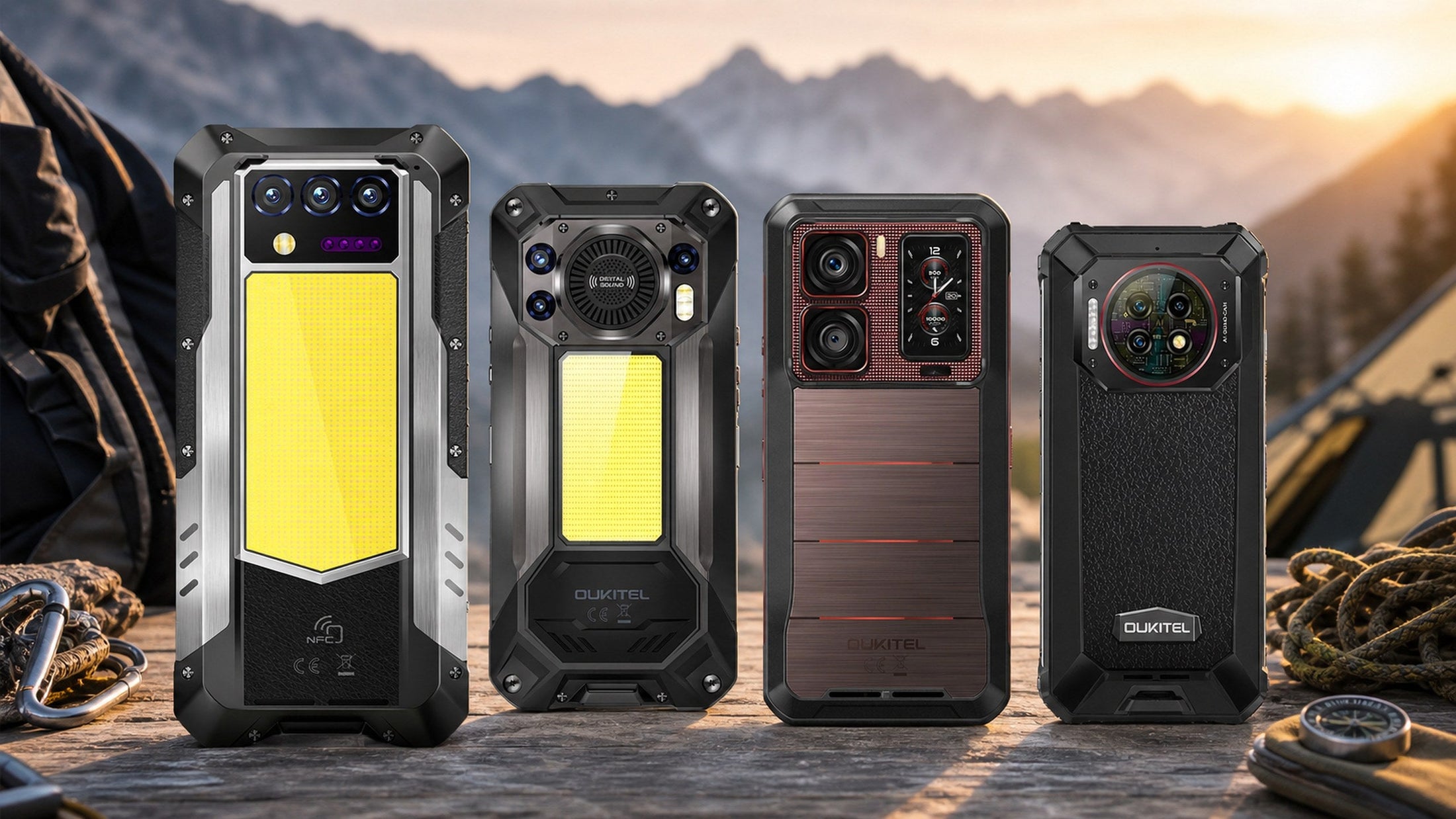
The best big-battery phone is not automatically the model with the highest mAh rating. Battery capacity matters, but so do efficiency, weight, charging time, reverse-charging output, network compatibility, performance, and the way you intend to carry the phone.
For maximum off-grid capacity, the OUKITEL WP100 Titan stands out with its 33,000mAh battery. The WP61 offers a more moderate 20,000mAh option with newer 5G hardware, while the WP300 balances a 16,000mAh battery with a lighter body and 18W reverse charging. The WP19 Pro remains an alternative for users who prioritize 22,000mAh endurance over 5G connectivity.
This guide compares these phones using the same criteria and explains the compromises behind their large batteries.
Quick Verdict
Best for Maximum Off-Grid Capacity: OUKITEL WP100 Titan
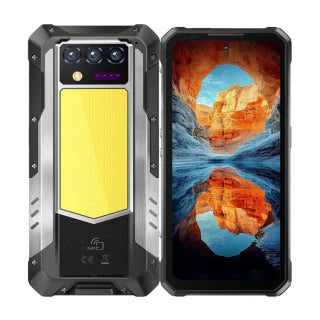
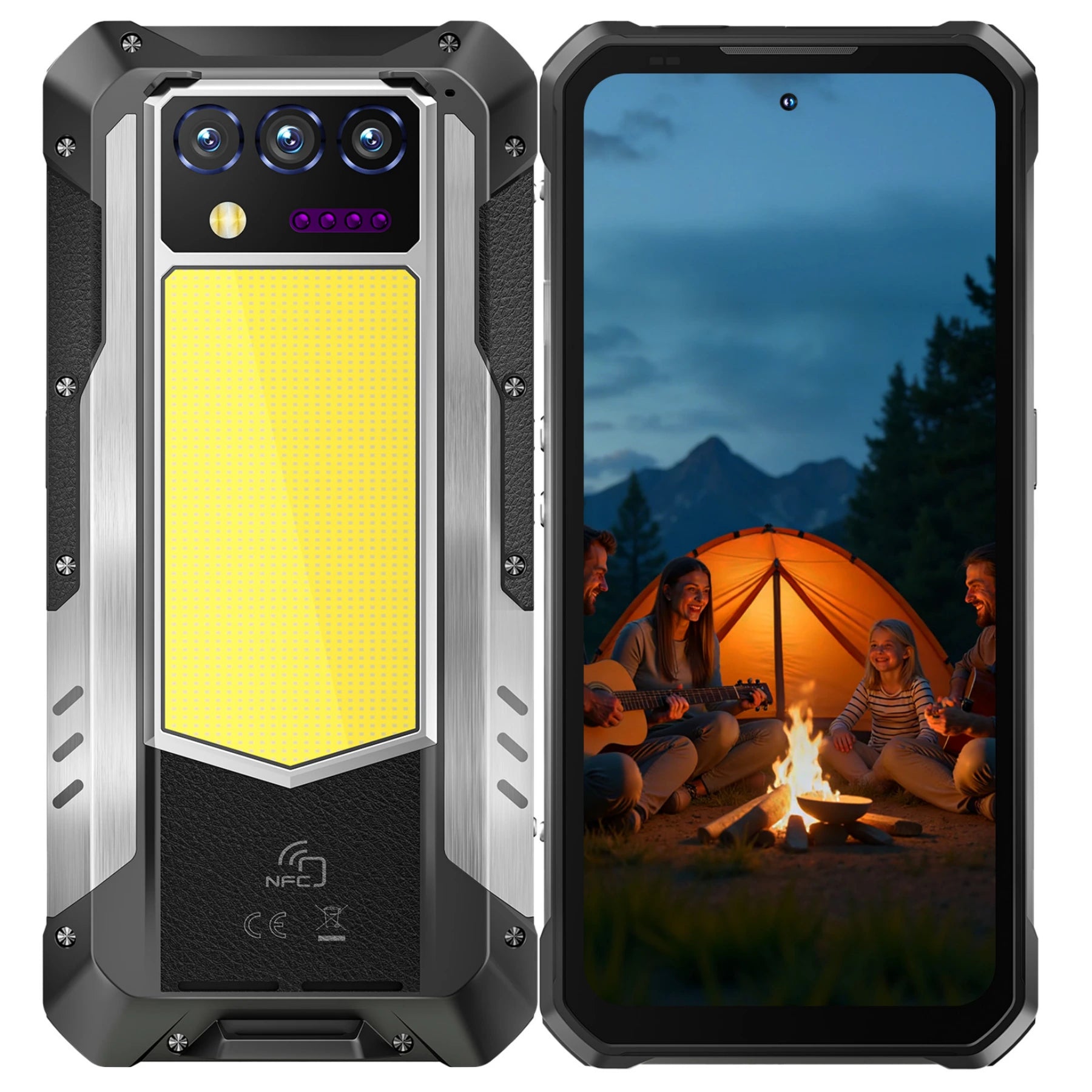
The OUKITEL WP100 Titan is the strongest choice when maximum stored energy is the priority. Its specifications include:
- 33,000mAh battery
- 66W input charging
- 18W reverse charging
- 5G MediaTek Dimensity 7300 processor
- 876.6g body weight
- 35.6mm thickness
- Built-in projector and camping light
This combination suits basecamps, remote worksites, extended overlanding trips, emergency preparation, and users who frequently need to power accessories.
The limitation is portability. At 876.6g, the WP100 Titan weighs substantially more than a conventional smartphone and should be treated as an all-in-one field device rather than a pocket-friendly everyday phone. Its availability may also vary by regional variant, so check the product page before planning a purchase.
Best for Long Endurance and Modern 5G Performance: OUKITEL WP61
The OUKITEL WP61 combines a 20,000mAh battery with a newer 5G platform and Android 16. Its listed specifications include:
- 20,000mAh battery
- 45W input charging
- Supported reverse charging
- MediaTek Dimensity 7025 processor
- 12GB RAM and 512GB storage
- 620.4g body weight
- 27.5mm thickness
The WP61 makes sense for field workers and outdoor users who want substantially more capacity than a conventional phone without moving to the WP100 Titan’s size and weight.
Its main compromise is that it is still a heavy, thick phone. OUKITEL confirms reverse-charging support but does not list a specific reverse-charging output on the current product page, so buyers should not assume that it matches the 18W output of the WP100 Titan or WP300.
Best for Balanced Capacity and Device Charging: OUKITEL WP300
The OUKITEL WP300 has the lowest battery capacity in this comparison, but its overall balance may make it the most practical choice for some users.
Key specifications include:
- 16,000mAh battery
- 45W input charging
- 18W reverse charging
- MediaTek Dimensity 7050 processor
- 5G and Wi-Fi 6
- 510g body weight
- 23.2mm thickness
- Modular detachable accessory system
Its 510g weight is still far above that of a mainstream smartphone, but it is 110.4g lighter than the WP61 and 366.6g lighter than the WP100 Titan. That difference can matter when the phone is carried throughout a work shift or attached to outdoor gear.
The WP300 is therefore a strong option for users who need long endurance and verified 18W device charging but do not require the largest available battery.
Best for 22,000mAh Endurance Without Requiring 5G: OUKITEL WP19 Pro
The WP19 Pro occupies a different position. Its 22,000mAh battery exceeds the WP61 and WP300, while its 592.3g body is lighter than the WP61.
Its specifications include:
- 22,000mAh battery
- 33W input charging
- Supported reverse charging
- MediaTek Helio G99 processor
- 4G connectivity
- 592.3g body weight
- 29mm thickness
- 20MP night-vision camera
The tradeoff is its older platform. The Helio G99 does not provide 5G, and 33W charging is slower than the 45W or 66W inputs offered by the newer alternatives. The WP19 Pro is most relevant when battery capacity and night vision matter more than current connectivity.
Availability and regional support should be confirmed before purchase because this is an older model.
Why the Highest mAh Number Is Not Always the Best Choice

Battery capacity is only one part of practical endurance. Two phones with different capacities may deliver a smaller runtime difference than their mAh numbers suggest if their screens, processors, signal conditions, and workloads are different.
Understand What Battery Capacity Actually Measures
Milliamp-hours measure electric charge rather than total stored energy. They are useful when comparing batteries with the same nominal voltage, but watt-hours provide a more complete measure of energy.
The conversion is:
Wh = (mAh ÷ 1,000) × nominal voltage
Do not calculate a phone’s flight eligibility or stored energy using an assumed voltage. Check the Wh rating printed on the device, battery label, packaging, or official documentation.
Capacity also does not tell you how quickly the energy can be replenished. A 33,000mAh phone with 66W charging and a 22,000mAh phone with 33W charging create very different charging routines, even though both require considerably longer than a typical slim smartphone.
Consider Screen, Processor, Signal, and Usage Efficiency
Actual runtime depends on how the phone consumes energy. Important variables include:
- Screen brightness and refresh rate
- Processor efficiency
- Cellular signal strength
- 4G or 5G activity
- GPS and offline navigation
- Camera and video recording
- Gaming and sustained processing
- Camping lights or projectors
- Reverse charging
- Ambient temperature
- Background applications
A large battery can still drain quickly when it powers a bright 120Hz display, navigation, a hotspot, a projector, or another device. Manufacturer runtime figures should be treated as controlled test results rather than guarantees for every user.
For a broader explanation of capacity and stored energy, see OUKITEL’s guide to how big a phone battery can be.
What to Compare Beyond Battery Capacity

A useful big-battery phone must be manageable when carried, reasonably efficient when recharged, and capable of handling the user’s actual applications.
Weight, Thickness, and Everyday Handling
Large batteries require physical space and add weight. In this comparison:
| Model | Battery | Weight | Thickness |
|---|---|---|---|
| WP100 Titan | 33,000mAh | 876.6g | 35.6mm |
| WP19 Pro | 22,000mAh | 592.3g | 29mm |
| WP61 | 20,000mAh | 620.4g | 27.5mm |
| WP300 | 16,000mAh | 510g | 23.2mm |
The WP100 Titan provides the most capacity but is the hardest to carry in a normal pocket. A belt pouch, pack compartment, vehicle mount, or hand strap may be more appropriate.
The WP300 is the lightest model here, although 510g remains significant. Buyers should compare the phone’s weight with what they currently carry rather than assuming that every rugged phone will feel similar.
Charging Power and the Time Required for a Full Recharge
Input wattage affects how practical a large battery feels. The comparison is:
- WP100 Titan: 66W
- WP61: 45W
- WP300: 45W
- WP19 Pro: 33W
Higher wattage does not mean the phone accepts peak power during the entire session. Charging normally slows as the battery approaches full capacity, and heat can reduce the rate.
The charger and cable must also support the phone’s charging protocol. A high-wattage adapter does not force the phone to charge faster than its supported input.
If you frequently return home with a low battery and need the device again within a few hours, input charging may matter more than adding another few thousand mAh.
Reverse-Charging Output and Device Compatibility
Reverse charging allows the phone to supply energy to another phone or accessory. It is useful for earbuds, watches, cameras, GPS devices, and emergency phone top-ups.
The WP100 Titan and WP300 list 18W reverse charging. The WP61 and WP19 Pro list reverse-charging support without stating the same output on their current specification pages.
Even when a phone supports power output, results depend on:
- The receiving device
- The cable
- The charging protocol
- The source battery level
- Temperature
- Automatic power cutoffs
Reverse charging also reduces the source phone’s remaining runtime. It should be considered part of the battery plan, not free additional energy. See the guide on how to charge one phone with another for connection and troubleshooting steps.
Connectivity, Performance, Storage, and Software
Battery life is valuable only if the phone can perform the required work.
The WP100 Titan, WP61, and WP300 support 5G. The WP19 Pro is limited to 4G. However, buyers must still check the listed network bands against their carrier and region.
The processors also differ:
- WP100 Titan: Dimensity 7300
- WP300: Dimensity 7050
- WP61: Dimensity 7025
- WP19 Pro: Helio G99
These names should not be evaluated in isolation. Consider the applications you use, storage requirements, navigation performance, camera workload, connectivity, and software version.
The WP61 offers Android 16 and 512GB storage on its current listing. The WP300 lists Android 15 and 512GB. The WP100 Titan specification page identifies Android 14 with an Android 15 upgrade available through OTA. Software information can change, so verify it immediately before purchase.
Key Specifications of the Best OUKITEL Big-Battery Phones
| Model | Best suited to | Battery | Input charging | Reverse charging | Network | Main limitation |
|---|---|---|---|---|---|---|
| WP100 Titan | Basecamps and maximum off-grid capacity | 33,000mAh | 66W | 18W | 5G | 876.6g weight |
| WP61 | Long field shifts with newer software | 20,000mAh | 45W | Supported; output not listed | 5G | 620.4g weight |
| WP300 | Balanced endurance and accessory charging | 16,000mAh | 45W | 18W | 5G | Less capacity than the other three |
| WP19 Pro | High capacity where 5G is unnecessary | 22,000mAh | 33W | Supported; output not listed | 4G | Older platform and slower charging |
Specifications were checked against OUKITEL pages on August 26, 2026. Prices, availability, software, and regional variants can change.
Strengths and Limitations in Real Use
Maximum-Capacity Phones Extend Runtime but Add Size and Weight
The WP100 Titan’s capacity is valuable when charging opportunities are rare. Its projector, camping light, and reverse charging can also reduce the number of separate devices needed in a basecamp or vehicle.
The same design is excessive for someone who mainly commutes between locations with accessible outlets. Carrying almost 877g every day may create a larger inconvenience than charging a smaller phone more frequently.
Faster Input Charging Reduces the Burden of a Large Battery
A big battery should be judged by both how long it runs and how easily it can be restored. The WP100 Titan’s 66W input helps compensate for its capacity, while the WP61 and WP300 provide 45W charging.
Charging time still requires planning. For long trips, charge before departure rather than relying on a short stop to fill an extremely large battery.
Reverse Charging Is Useful but Cannot Replace Every Power Bank
A large-battery phone can provide an emergency top-up without requiring another battery pack. This is convenient when reducing the number of devices carried is more important than maximizing total available energy.
A dedicated, reputable power bank can still be better when several people need power, the primary phone must remain fully charged, or charging equipment needs more output. OUKITEL’s big-battery phone and power-bank comparison covers this tradeoff in more detail.
Manufacturer Runtime Claims Depend on Test Conditions
Standby, calling, music, video, and gaming figures are not interchangeable. A strong signal, low brightness, and local video playback create different results from poor coverage, maximum brightness, 5G hotspot use, GPS, or recording video.
Compare manufacturer figures only when the test methods are sufficiently similar. For personal planning, your own screen time, signal conditions, and applications are more useful than the largest advertised runtime.
Which Big-Battery Phone Fits Each User?

Multi-Day Camping, Emergency Backup, and Remote Expeditions
Choose the WP100 Titan when maximum capacity, reverse charging, lighting, and an integrated projector provide real value. Confirm that its weight and airline implications fit the trip.
The WP61 may be more manageable when 20,000mAh is sufficient and the projector is unnecessary.
Construction, Field Service, and Long Work Shifts
The WP61 offers a strong combination of capacity, 5G, current software, storage, and rugged construction. The WP300 is easier to carry and may be preferable when workers need 18W reverse charging or its modular accessories.
Check network bands, required applications, mounting equipment, and workplace device-management policies before selecting either model.
Travel, Navigation, Photography, and Device Charging
The WP300 offers the most balanced dimensions in this group. Its 16,000mAh battery remains large, while its 510g weight is lower than the other compared models.
Travelers who need the greatest possible reserve may prefer the WP100 Titan, but they should examine airline battery rules before arriving at the airport. Those still comparing the wider range can review the current OUKITEL rugged phone collection.
FAQ
How Can You Convert a Phone Battery From mAh to Wh?
Divide mAh by 1,000 to obtain Ah, then multiply by the battery’s nominal voltage:
Wh = (mAh ÷ 1,000) × V
Use the voltage printed on the battery or official documentation. Do not assume that all phone batteries use exactly the same nominal voltage.
Can You Take a 20,000mAh or 33,000mAh Phone on an Airplane?
It depends on the battery’s Wh rating and the airline’s rules. The U.S. FAA states that rechargeable batteries from 0–100Wh are generally allowed on passenger aircraft, batteries from 101–160Wh require airline approval, and batteries above 160Wh are prohibited. Devices placed in checked baggage must be powered off and protected from accidental activation. Check the current FAA battery guidance and contact the airline before traveling.
Does a Larger Phone Battery Take More Years to Degrade?
Not necessarily. Battery aging depends on chemistry, temperature, charge cycles, charging habits, storage level, and power demand. A larger battery may require fewer full equivalent cycles under the same workload, but capacity alone does not guarantee a longer service life.
Should You Choose More Capacity or Faster Charging?
Choose more capacity when outlets are unavailable for long periods. Prioritize faster charging when you regularly have brief access to power and want to reduce recovery time. Many users benefit most from a balance between capacity, weight, and charging speed.
Conclusion
The WP100 Titan is the best OUKITEL option for maximum capacity, but it is also the largest and heaviest. The WP61 provides 20,000mAh endurance with 5G and newer software, while the WP300 offers the most balanced combination of weight, 45W input, and 18W reverse charging. The WP19 Pro remains a high-capacity 4G alternative where newer connectivity is not essential.
Before choosing, compare mAh with weight, thickness, charging time, reverse-charging output, network bands, processor, software, and the features you will actually use. The best big-battery phone is the one that provides enough endurance without creating unnecessary compromises every time you carry or recharge it.


Leave a comment
Your email address will not be published. Required fields are marked *