


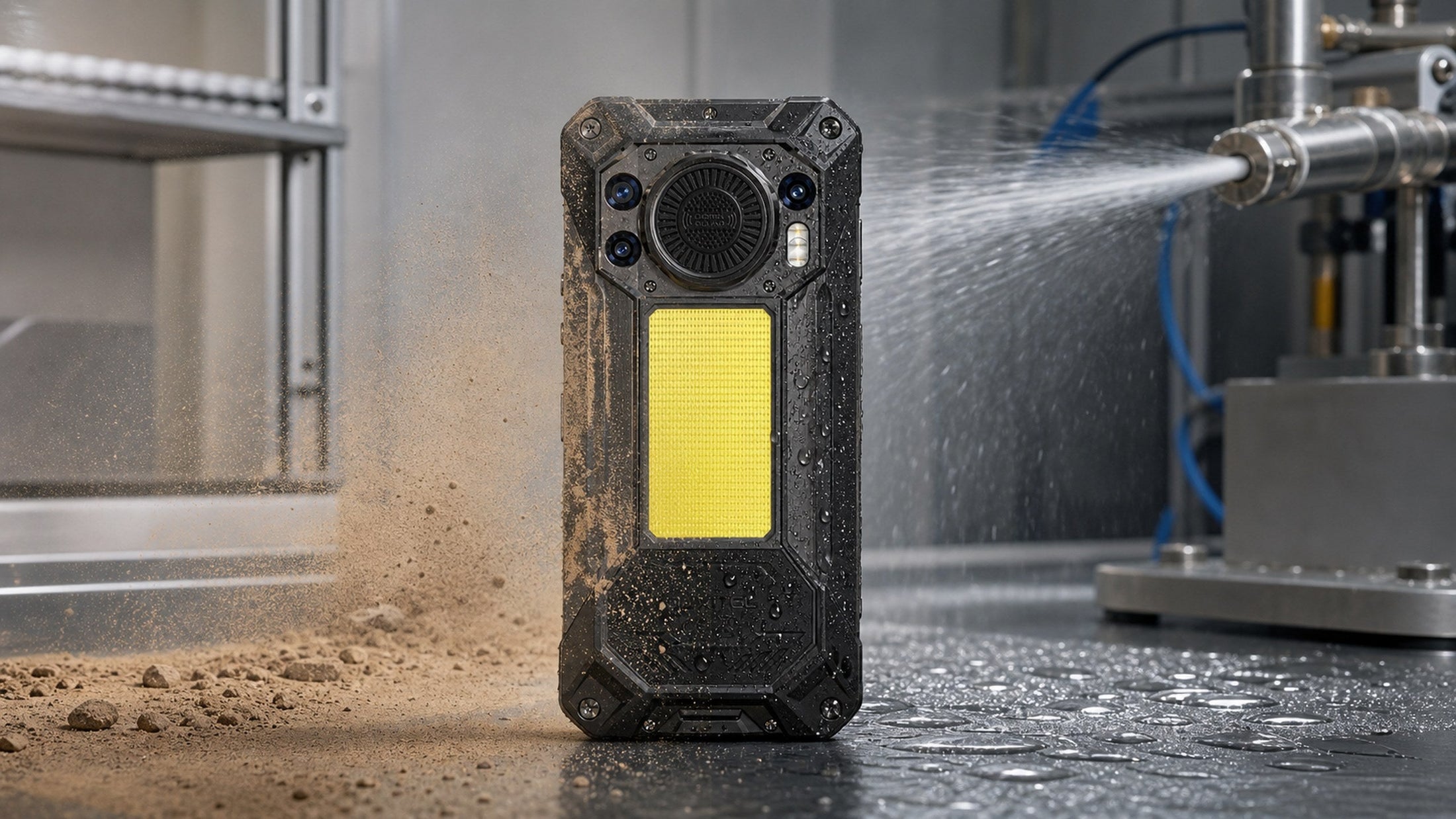
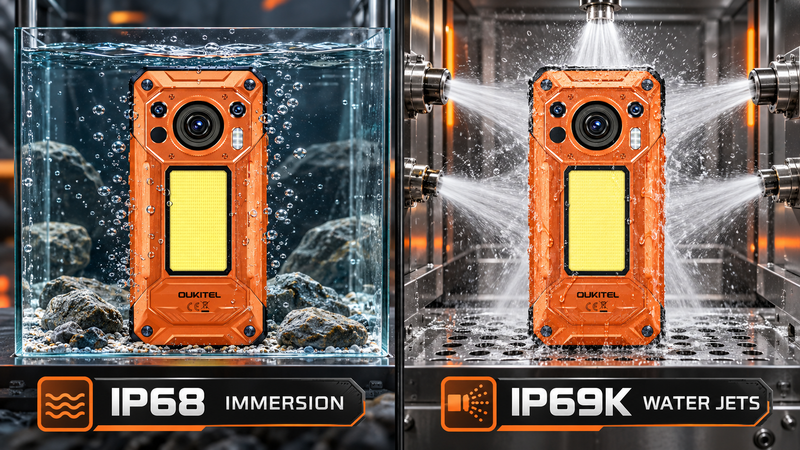
IP68 and IP69K describe different types of protection against dust and water. IP68 indicates the highest numbered protection against solid-particle ingress and protection during immersion under conditions specified by the manufacturer. IP69K addresses exposure to close-range, high-pressure, high-temperature water jets.
A rugged phone may have both ratings because passing an immersion test does not automatically prove that its enclosure can resist forceful water jets. Likewise, an IP69K rating does not establish how the phone performs during extended immersion.
Neither rating makes a phone permanently waterproof or indestructible. The test standard, stated depth, exposure time, condition of the seals, previous impacts, liquid type, and manufacturer instructions all matter.
IP68 vs. IP69K: What Is the Difference?
The simplest distinction is:
- IP68 focuses on dust and immersion.
- IP69K focuses on dust and high-pressure, high-temperature water jets.
| Rating | Solid-particle protection | Water protection | Typical relevance |
|---|---|---|---|
| IP68 | Dust-tight | Immersion under manufacturer-specified conditions | Rain, puddles and accidental immersion |
| IP69K | Dust-tight | Close-range, high-pressure, high-temperature water jets | Controlled washdown and demanding industrial exposure |
The ratings should not be ranked as if IP69K were simply “better waterproofing” than IP68. They represent different tests.
For a worker exposed to rain and an occasional drop into water, the manufacturer’s IP68 immersion conditions may be most relevant. For equipment used around controlled high-pressure washdown, IP69K may add useful information. A device carrying both ratings has been assessed for both types of exposure, subject to its stated conditions and limitations.
How to Read an IP Rating
The IP system classifies the protection provided by an enclosure against access to hazardous parts, solid objects and water. IEC 60529 is the principal international standard associated with the IP Code. The IEC overview identifies IEC 60529 as the standard for degrees of protection provided by enclosures.
An IP rating normally contains two digits after “IP.”
The First Digit Measures Protection Against Solid Objects
The first digit indicates the level of protection against access and solid foreign objects.
In both IP68 and IP69K, the first digit is 6. This represents the highest numbered level of solid-particle ingress protection and is commonly described as dust-tight.
That does not mean dust can never cause a problem. Fine material can still accumulate around external components such as:
- Charging-port covers
- Speaker grilles
- Microphone openings
- Buttons
- Camera surrounds
- Enclosure seams
Concrete dust, sand, metal particles and abrasive grit can affect moving parts or connectors even if they do not enter the protected internal enclosure during the standard test.
The Second Digit Measures Protection Against Water
The second digit addresses water exposure. The meaning changes according to the number and the applicable standard.
For IP68, the water digit is 8, indicating immersion protection beyond the conditions associated with the preceding immersion level. The precise depth and duration are not universal across every IP68 product; the manufacturer must state the applicable conditions.
For IP69K, the water portion addresses high-pressure, high-temperature jets. This test concerns the enclosure’s ability to prevent harmful water ingress during a specific spray procedure.
Do not interpret the second digit as a simple linear scale in which one test includes every previous real-world scenario. Immersion and forceful water jets place different stresses on seals and openings.
Missing Digits and the Meaning of an “X”
An “X” means that a protection level has not been specified for that position. It does not automatically mean the enclosure has no protection.
For example:
- IP6X identifies a specified dust-protection level without declaring a water level in that code.
- IPX8 identifies a specified immersion-protection level without declaring a solid-particle level in that code.
A complete IP68 rating specifies both. Buyers should examine the full rating instead of focusing only on the water digit.
What IP68 Means for a Rugged Phone

IP68 is useful for phones exposed to dust, rain and accidental immersion, but its meaning must be read together with the manufacturer’s test conditions.
Protection Against Dust Ingress
The “6” means the enclosure is dust-tight under the relevant test. This is valuable for construction sites, workshops, farms, trails and other environments where fine particles are common.
The rating applies to the enclosure in its tested configuration. Port covers must be properly closed, seals must be intact, and the body must not have been compromised by previous damage.
External dust should still be removed carefully. Allowing abrasive material to remain around a charging port or button can create wear even when the internal enclosure remains protected.
Water Immersion Under Manufacturer-Specified Conditions
IP68 does not create one universal depth and duration for every phone. A manufacturer may specify a particular depth, time, water condition and test setup.
When comparing two IP68 phones, check:
- Maximum stated depth
- Maximum stated duration
- Whether the test used fresh water
- Required position of port covers
- Whether the phone must remain stationary
- Temperature conditions
- Cleaning and drying instructions
A claim such as “IP68” without accessible test conditions is less informative than a rating accompanied by a specific immersion depth and time.
Why IP68 Does Not Mean Permanently Waterproof
Water resistance can change over time. Impacts, twisting, temperature cycles, worn seals and repairs can affect the enclosure.
IP68 also does not necessarily cover:
- Swimming with the phone
- Diving
- Fast-moving water
- Saltwater
- Chlorinated pool water
- Soap and detergent
- Oils and solvents
- Concrete slurry
- Steam
- Charging while wet
Movement through water can create pressure that differs from a stationary laboratory immersion test. Chemicals and salt can also affect seals, coatings and exposed connectors differently from clean test water.
Treat IP68 as protection under stated conditions, not permission to expose the phone to water unnecessarily.
What IP69K Means for a Rugged Phone

IP69K is especially relevant to equipment that may encounter forceful washdown. ISO 20653 defines protection codes for enclosures used with electrical equipment in road vehicles, including protection against foreign objects, water and access. The current edition is ISO 20653:2023.
Manufacturers commonly use IP69K terminology when describing rugged devices designed for demanding water-jet exposure.
Protection Against High-Pressure, High-Temperature Water Jets
The test directs high-pressure, high-temperature water toward the enclosure from defined positions under controlled conditions.
This is different from immersion. During immersion, water pressure is distributed around the submerged enclosure. A water jet applies concentrated force to particular areas, including seams, buttons, speaker openings and port covers.
IP69K can therefore be relevant to:
- Controlled equipment washdown
- Mud and dirt removal
- Agricultural environments
- Vehicle maintenance
- Industrial work areas
- Outdoor equipment exposed to forceful spray
The test still has defined limits. A real pressure washer can vary in pressure, temperature, nozzle shape, distance, angle and duration.
Why IP69K Does Not Replace an IP68 Immersion Rating
A phone can resist a controlled water jet and still require a separate test to establish immersion performance. This is why a rugged phone may list both IP68 and IP69K.
The ratings answer different questions:
- IP68: Can the enclosure resist harmful ingress during the stated immersion?
- IP69K: Can the enclosure resist harmful ingress during the specified high-pressure, high-temperature spray test?
Users who face both risks should look for both ratings and read the supporting conditions.
How IP69K Applies to Worksites and Equipment Cleaning
IP69K may be useful when a phone is carried around mud, rain, equipment cleaning or spray. It does not mean workers should intentionally pressure-wash the device.
Before any cleaning:
- Follow the phone’s user manual.
- Confirm that all port covers are closed.
- Inspect the enclosure for cracks or deformation.
- Keep the device away from chemicals not covered by its instructions.
- Allow the phone and charging port to dry completely.
- Stop using it if moisture appears inside a camera or display.
The safest cleaning method is the one specified by the manufacturer, not the most forceful method the rating appears to allow.
A Real Example: OUKITEL WP61
The OUKITEL WP61 provides a practical example of a phone carrying both ratings.
Its current product specifications list:
- IP68
- Immersion in 1.5 meters of water for up to 30 minutes
- IP69K
- MIL-STD-810H
- Operating temperature range of –20°C to 55°C
The immersion statement makes its IP68 claim more useful because it identifies a depth and duration. The separate IP69K claim addresses high-pressure water-jet exposure.
These specifications do not authorize unlimited immersion, pressure washing at any distance, underwater charging or exposure to saltwater and industrial chemicals. They apply to an intact device used within its documented conditions.
The phone’s port covers, enclosure and seals must remain correctly positioned and undamaged. After exposure, users should inspect the device and wait until the port is completely dry before connecting a charging cable.
Other models can be compared through the OUKITEL rugged phone collection, but each product page should be checked individually. Do not assume that every device has identical immersion conditions simply because several list IP68.
Which Rating Matters for Different Uses?
The most relevant rating depends on the expected exposure.
Rain, Puddles, Hiking and Accidental Immersion
IP68 is usually the more directly relevant water rating when the main concerns are heavy rain, a dropped phone or brief accidental immersion.
Hikers and campers should still store the phone securely and keep charging ports dry. A waterproof pouch can add another layer of protection around river crossings, kayaking or prolonged storms.
For outdoor-device selection beyond IP ratings, see the guide to the best phones for camping and hiking.
Construction, Agriculture, Workshops and Washdown Areas
IP69K may be useful when the device could encounter forceful spray or controlled washdown. IP68 remains relevant when puddles, tanks, ditches or accidental submersion are also possible.
Construction workers should consider dust, drops, gloves, carrying method and hazardous-location requirements in addition to water protection. The guide to rugged phones for construction workers covers those factors separately.
When a Phone Should Have Both IP68 and IP69K
Look for both ratings when a device may experience immersion and high-pressure spray.
Examples include:
- Agriculture and livestock operations
- Outdoor utilities
- Construction and maintenance
- Vehicle and equipment service
- Remote fieldwork
- Wet industrial environments
Even then, verify the precise product conditions. Two phones with the same rating can have different manufacturer instructions, stated depths and warranty terms.
What IP68 and IP69K Do Not Tell You
IP ratings are specific to ingress protection. They do not summarize every type of ruggedness.
Drop, Shock and Vibration Protection
IP68 and IP69K do not establish drop height, impact resistance or vibration performance. These characteristics require different tests and claims.
MIL-STD-810H is often listed alongside IP ratings, but it is also not one single pass-or-fail durability level. Buyers should check which methods were applied and the manufacturer’s stated drop conditions.
A phone can retain its original appearance after a drop while suffering hidden seal damage. Inspect it before relying on its water resistance again.
Resistance to Saltwater, Chemicals, Steam and Abrasive Materials
The IP code does not automatically establish compatibility with every liquid or contaminant.
Saltwater can corrode exposed contacts. Soap can reduce surface tension and behave differently around seals. Solvents and oils may affect adhesives or polymers. Concrete slurry can combine fine abrasive material with alkaline moisture.
Steam presents another challenge because heat and vapor can affect seals differently from liquid water.
Follow the manual after any non-freshwater exposure. Do not improvise a rinse or cleaning procedure when the manufacturer’s instructions are unavailable.
Seal Aging, Previous Damage, Repairs and Warranty Coverage
Water resistance is not necessarily permanent. It may be affected by:
- Normal wear
- Repeated drops
- A cracked screen
- A bent frame
- A loose port cover
- Battery swelling
- Previous disassembly
- An unapproved screen or battery repair
- Dirt trapped around a seal
Warranty coverage is a separate issue from laboratory ratings. A phone can have an IP rating while its warranty excludes some forms of liquid damage, misuse or exposure outside the stated conditions.
Read the warranty before purchase and document the device’s condition if it is deployed as work equipment.
How to Maintain a Rugged Phone’s Water and Dust Resistance

Regular inspection helps preserve the protection the enclosure was designed to provide.
Inspect Port Covers, Seals and the Enclosure Before Exposure
Check for:
- Cracks in the display or body
- Deformed corners
- Loose port covers
- Missing seals
- Dirt around cover edges
- Gaps between enclosure sections
- Swelling or separation
- Camera condensation
Do not deliberately expose a damaged phone to water to test whether the seals still work.
Clean and Dry the Phone Correctly After Outdoor or Worksite Use
Use the cleaning procedure in the product manual. Avoid inserting metal objects into ports or directing uncontrolled pressure into speaker and microphone openings.
Before charging:
- Remove visible surface moisture.
- Open covers only when the surrounding area is dry.
- Inspect the port for water or debris.
- Allow enough drying time.
- Stop if the connector becomes hot or unstable.
An external dry surface does not always mean the charging port is ready.
Stop Relying on the Rating After Significant Damage or Repair
After a severe impact, crushed enclosure or non-authorized repair, assume the original water protection may have changed until the device has been properly inspected.
Replacement screens, adhesives, seals and assembly procedures affect enclosure performance. Ask the repair provider whether water-resistance testing was completed after service and what that test actually covered.
FAQ
Can You Take Underwater Photos With an IP68 Phone?
Only if the manufacturer explicitly permits that use within stated depth, duration and water conditions. IP68 alone should not be treated as authorization for underwater photography, swimming or diving.
Does IP69K Mean You Can Clean a Phone With a Pressure Washer?
No. IP69K represents a controlled test. A pressure washer may use different pressure, temperature, distance, nozzle pattern and exposure time. Follow the manufacturer’s cleaning instructions.
Can a Screen or Battery Repair Affect the Phone’s IP Rating?
Yes. Opening the enclosure can disturb adhesives, gaskets and seals. Water resistance should not be assumed after repair unless the device is correctly resealed and tested.
Why Might Water Damage Be Excluded From a Phone Warranty?
An IP rating applies under defined laboratory conditions, while real damage may involve worn seals, saltwater, chemicals, excessive depth, prolonged exposure or misuse. Warranty coverage is determined by the manufacturer’s written terms.
Conclusion
IP68 and IP69K protect against different water hazards. IP68 covers dust and manufacturer-specified immersion, while IP69K addresses high-pressure, high-temperature water jets. A rugged phone may need both when it faces immersion and forceful spray.
Neither rating guarantees permanent waterproofing. Check the exact depth, time, test standard, care instructions and warranty for the individual model. Keep port covers closed, inspect the enclosure after impacts, clean the phone correctly and never connect a charger while the port is wet.
The most useful IP rating is not the highest-looking number. It is the rating that matches the device’s real environment and is supported by clear, verifiable test conditions.


Leave a comment
Your email address will not be published. Required fields are marked *